


Table of Contents
- How Contractors Can Reduce Taxes
- Top 25 Tax Deductions for Contractors
- Vehicle Expenses: The Complete Guide
- Tools and Equipment Deductions
- Capital Cost Allowance (CCA) for Equipment
- Home Office Deduction for Contractors
- Meals, Travel, and Entertainment
- What You CANNOT Deduct
- Record Keeping Requirements
Don’t overpay your share of taxes.
Because most contractors don’t track and claim all the legitimate deductions they’re entitled to, you’re leaving thousands of dollars on the table every year—money that should stay in your business, not go to the government.
The average contractor client who comes to us for bookkeeping uncovers $8,000-$15,000 in missed deductions in their first year. That’s real money. Sometimes enough to buy a new truck, hire another crew member, or simply take a breath instead of living paycheck to paycheck.
This comprehensive guide covers every legitimate tax deduction available to Canadian contractors, from obvious expenses like materials to often-missed opportunities like vehicle depreciation and home office claims. We’ll explain what you can deduct, how to calculate it, and what documentation CRA requires.

How Contractors Can Reduce Taxes
Before we dive into specific deductions, let’s understand how contractors can systematically overpay in taxes.
The Common Scenario
Tom’s Electrical Services grossed $180,000 in revenue. Tom paid $95,000 in direct job costs (materials, subs). His accountant calculated taxes on $85,000 profit.
Tom paid $18,700 in income tax.
But Tom didn’t track:
- Vehicle expenses for his work truck: $8,200
- Tools and small equipment: $3,400
- Home office expenses: $2,800
- Safety gear and work clothing: $950
- Professional development: $800
- Licensing and permits: $650
- Insurance: $3,600
- Phone and internet: $1,200
Total missed deductions: $21,600
His actual taxable income should have been $63,400, not $85,000.
Corrected tax bill: $11,900
Tom overpaid by $6,800 because he didn’t track legitimate business expenses.
Why This Happens
No receipt tracking system
Receipts stay in the truck, get thrown away, or disappear. Come tax time, you have no records.
Not knowing what’s deductible
You assume something isn’t deductible, so you don’t track it. (Spoiler: Most business expenses ARE deductible.)
DIY bookkeeping gaps
You remember big expenses but forget hundreds of small purchases that add up to thousands.
Poor categorization
Everything goes into “materials” or “supplies.” You don’t separate deductible items from non-deductible personal expenses.
No proactive tax planning
You think about taxes in April when filing, not throughout the year when you could make strategic decisions.
The Cost of Missed Deductions
Immediate: Higher tax bill this year
Compound: Overpaying year after year multiplies the loss
Opportunity: That $6,800 Tom overpaid could have:
- Bought new tools ($3,000) and still saved $3,800
- Funded marketing to grow the business
- Built emergency cash reserves
- Paid down debt faster
Proper expense tracking and deduction optimization isn’t about cheating or pushing boundaries. It’s about keeping what’s legitimately yours.
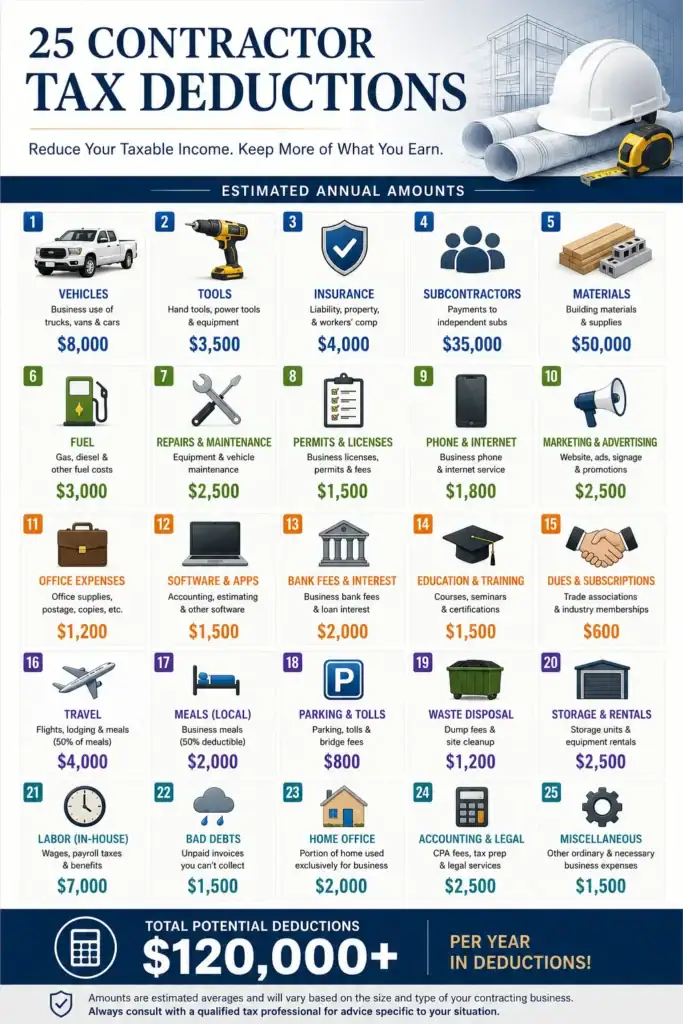
Top 25 Tax Deductions for Contractors
Let’s cover the most valuable deductions for Canadian contractors. We’ll go deep on vehicles, equipment, and home office in later sections.
1. Materials and Supplies
What it includes: Lumber, drywall, electrical wire, plumbing fixtures, paint, concrete, fasteners—any materials used in projects.
How to deduct: Full cost in the year purchased (for jobs completed that year).
Key tip: Keep supplier receipts organized by job. This supports job costing AND tax deductions.
2. Subcontractor Payments
What it includes: Money paid to subcontractors (electricians, plumbers, HVAC, etc.).
How to deduct: Full amount paid.
Key tip: Remember T5018 reporting requirements—if you pay a subcontractor over $500 annually, you must file.
3. Advertising and Marketing
What it includes: Website costs, business cards, vehicle wraps/signage, online advertising (Google, Facebook), print ads, promotional items, trade show booths.
How to deduct: 100% deductible.
Key tip: Track website hosting separately from website development (development may be capital expense requiring CCA).
4. Vehicle Expenses
Covered in detail in next section
5. Insurance
What it includes: Liability insurance, commercial vehicle insurance, equipment insurance, workers’ compensation (WSIB), bonding.
How to deduct: 100% deductible.
Key tip: Don’t forget WSIB—it’s often a significant expense contractors overlook.
6. Business Licenses and Permits
What it includes: Contractor license fees, business license, building permits (if you pay them), professional association dues, certifications.
How to deduct: 100% deductible.
Key tip: Some permits are project-specific (you bill to customer); others are general business expenses (you deduct).
7. Office Expenses
What it includes: Office supplies, printer ink, paper, postage, bank fees, software subscriptions (QuickBooks, project management tools).
How to deduct: 100% deductible.
Key tip: Keep personal and business bank accounts separate. Mixed accounts make deductions impossible to prove.
8. Professional Fees
What it includes: Accountant fees, bookkeeper fees, lawyer fees (for business matters), business consultant fees.
How to deduct: 100% deductible.
Key tip: Good bookkeeping pays for itself in tax savings. Professional fees are deductible, and accurate books maximize other deductions.
9. Rent (Office, Shop, or Yard Space)
What it includes: Office rent, shop space, equipment yard, storage units for tools/materials.
How to deduct: 100% of business portion.
Key tip: If you rent space used partially for business and partially personal, only deduct business percentage.
10. Utilities
What it includes: Electricity, natural gas, water for business locations.
How to deduct: 100% for dedicated business space; proportionate for mixed-use.
Key tip: Job site temporary utilities are deductible; usually allocated to specific job costs rather than general expense.
11-25. Additional Common Deductions
- Safety equipment and gear (hard hats, safety glasses, reflective vests, harnesses)
- Small tools (drills, saws, hammers—under $500 each)
- Maintenance and repairs for tools and equipment
- Fuel for business vehicles
- Parking and tolls for business travel
- Training and professional development (trade courses, certification programs)
- Trade magazines and publications
- Phone and internet (business portion)
- Equipment rental (scaffolding, lifts, specialty tools)
- Waste disposal (dumpsters, dump fees)
- Cleaning and laundry for work clothing
- First aid supplies and safety compliance
- Security systems for shop or yard
- Signage for business locations
- Interest on business loans or lines of credit
Vehicle Expenses: The Complete Guide
For most contractors, vehicle expenses are the single largest missed deduction. Let’s get this right.
Business Use Percentage
Critical concept: You can only deduct the business-use percentage of vehicle expenses.
Example:
- Total km driven in year: 32,000 km
- Business km: 25,600 km (80%)
- Personal km: 6,400 km (20%)
- Business use: 80%
If total vehicle expenses are $10,000, you deduct $8,000 (80%).
Tracking Business vs. Personal Use
Mileage log requirement: CRA requires a log showing:
- Date of each trip
- Starting location and destination
- Business purpose
- Kilometers driven
Example log entry:
Date: Feb 15, 2025
From: Home (workshop)
To: Johnson job site (123 Maple St)
Purpose: Deliver materials and inspect framing
Km: 24 km
Three tracking methods:
1. Detailed paper/digital log
- Record every trip
- Most accurate
- Most tedious
2. Representative period sample
- Log one representative month per quarter
- CRA accepts if consistent pattern
- Less paperwork
3. Mileage tracking apps
- MileIQ, Everlance, TripLog
- GPS-based automatic tracking
- Categorize trips as business/personal
- Generates CRA-compliant reports
Our recommendation: Use an app. The $60-$100 annual subscription pays for itself many times over in time saved and accuracy.
What Vehicle Expenses Are Deductible?
Operating expenses (deduct business %):
- Fuel
- Oil changes and maintenance
- Repairs
- License and registration
- Insurance (vehicle portion—see limits below)
- Car washes
- Parking (business trips)
- 407 ETR or other tolls (business)
Example:
- Total operating expenses: $8,500
- Business use: 80%
- Deductible: $6,800
Capital Cost Allowance (vehicle depreciation):
Vehicles are capital assets. Instead of deducting the full purchase price, you claim CCA (covered in detail later).
Passenger Vehicle Limits
Important: CRA limits deductions on “passenger vehicles” (cars, SUVs, trucks).
Current limits (2025):
- Maximum vehicle cost for CCA: $36,000 + sales tax (before calculating CCA)
- Maximum monthly lease cost: $950 + sales tax
- Maximum interest on vehicle loan: $350/month
Even if you bought a $70,000 truck, CCA calculation uses maximum $36,000 + tax.
Exception: Vehicles designed primarily for cargo (cargo vans, cube vans, dump trucks) may not be subject to these limits if they meet specific criteria.
Company-Owned vs. Personal Vehicle
Option 1: Business owns vehicle
- Purchase/lease in company name
- Deduct all business expenses
- Subject to passenger vehicle limits
- If you use personally, may create taxable benefit
Option 2: You own vehicle personally
- Purchase/lease in your name
- Claim business-use percentage
- Keep mileage log
- No taxable benefit issues
Option 3: Mileage reimbursement (if incorporated)
- Corporation pays you per-km rate
- Current CRA rates: $0.70/km first 5,000 km, $0.64/km after (2025 rates—check current)
- No mileage log needed if using standard rates
- Simple but may not maximize deduction
Consult your accountant on best structure for your situation.
Common Vehicle Deduction Mistakes
❌ No mileage log: CRA will disallow entire deduction in audit
❌ Claiming 100% business use: Unless you have a dedicated work vehicle AND a separate personal vehicle, 100% business use is an immediate red flag.
❌ Deducting commuting: Home to regular place of business is personal, not deductible. Exceptions exist for home-based businesses.
❌ Missing parking and tolls: Small amounts add up
❌ Forgetting vehicle registration and insurance: Easy to overlook but fully deductible (business %)
Tools and Equipment Deductions
Contractors invest heavily in tools. Maximize these deductions.
The $500 Rule
Tools/equipment under $500: Deduct full cost in year purchased.
Example:
- Cordless drill: $280 — Full deduction
- Table saw: $420 — Full deduction
- Laser level: $380 — Full deduction
Add them all up—these “small” purchases often total $3,000-$5,000 annually.
Tools Over $500
Tools and equipment over $500 are capital assets requiring CCA (depreciation).
Example:
- Commercial-grade saw: $2,100
- Cannot deduct $2,100 immediately
- Claim CCA over several years (Class 8, typically 20% declining balance)
More on CCA in next section.
Safety Equipment and Work Clothing
Safety equipment (deductible):
- Hard hats, safety glasses
- Reflective vests
- Safety harnesses and fall protection
- Respirators and hearing protection
- Steel-toe boots (if required for work)
Regular work clothing (NOT deductible):
- Jeans
- Regular T-shirts
- Non-specialized footwear
Key test: Is it required for your trade AND not suitable for everyday wear? Deductible. Could you wear it casually outside work? Not deductible.
Exception: Clothing with company logo prominently displayed may be deductible as advertising expense.
Tool Maintenance and Repairs
Deductible:
- Sharpening saw blades
- Tool repairs
- Equipment maintenance
- Replacement parts
Keep receipts for these ongoing costs.
Tool Theft or Loss
If tools are stolen or destroyed:
- Under $500 tools: Were already expensed, no further deduction
- Over $500 tools (CCA assets): May claim terminal loss or insurance proceeds affect UCC
Consult accountant for specific situation. Police report and insurance claim documents essential.
Capital Cost Allowance (CCA) for Equipment
When you buy expensive equipment, you don’t deduct the full cost immediately. Instead, you claim CCA (depreciation) over multiple years.
How CCA Works
Example: Buy a $30,000 truck
Year 1:
- CCA rate for Class 10 (vehicles): 30%
- Half-year rule applies first year: 15%
- CCA claim: $30,000 × 15% = $4,500
Year 2:
- Remaining value (UCC): $30,000 – $4,500 = $25,500
- CCA claim: $25,500 × 30% = $7,650
Year 3:
- Remaining UCC: $25,500 – $7,650 = $17,850
- CCA claim: $17,850 × 30% = $5,355
And so on, until fully depreciated.
Common CCA Classes for Contractors
| Asset Type | Class | Rate |
|---|---|---|
| Passenger vehicles (<$36K) | 10 | 30% |
| Vehicles for cargo/passengers (>$36K) | 10.1 | 30% |
| General tools, equipment | 8 | 20% |
| Computer equipment | 50 | 55% |
| Application software | 12 | 100% |
| Buildings/structures you own | 1, 3, 6 | varies |
| Trailers | 10 | 30% |
| Construction equipment | 22 | 50% (some items) |
Full list: CRA Capital Cost Allowance rates
Key CCA Rules
1. Half-year rule
First year, claim only half the normal CCA rate (exceptions exist for certain accelerated measures).
2. You don’t have to claim maximum
You can claim less than the maximum CCA in a year (or none). Strategic in low-income years.
3. Separate classes
Different asset types go in different CCA classes. Track each separately.
4. When you sell assets
Sale price affects UCC. If you sell for more than UCC, you may have recapture (taxable). If less, you may have terminal loss (deductible).
Complex: Work with your accountant on CCA calculations and strategy.
Accelerated Investment Incentive
Recent Accelerated Investment Incentives allow enhanced first-year CCA deductions for eligible assets purchased after certain dates.
Check with accountant: You may be able to claim more CCA in year 1 than traditional half-year rule would allow.
Home Office Deduction for Contractors
Many contractors work from home—using part of their residence for office, storage, or workshop. This creates deduction opportunities.
Qualifying for Home Office Deduction
Two tests (must meet ONE):
Test 1: Home office is your principal place of business (where you do most administrative work, meet clients regularly).
Test 2: You use it exclusively for business on a regular basis to earn income (dedicated storage for tools/materials, home workshop).
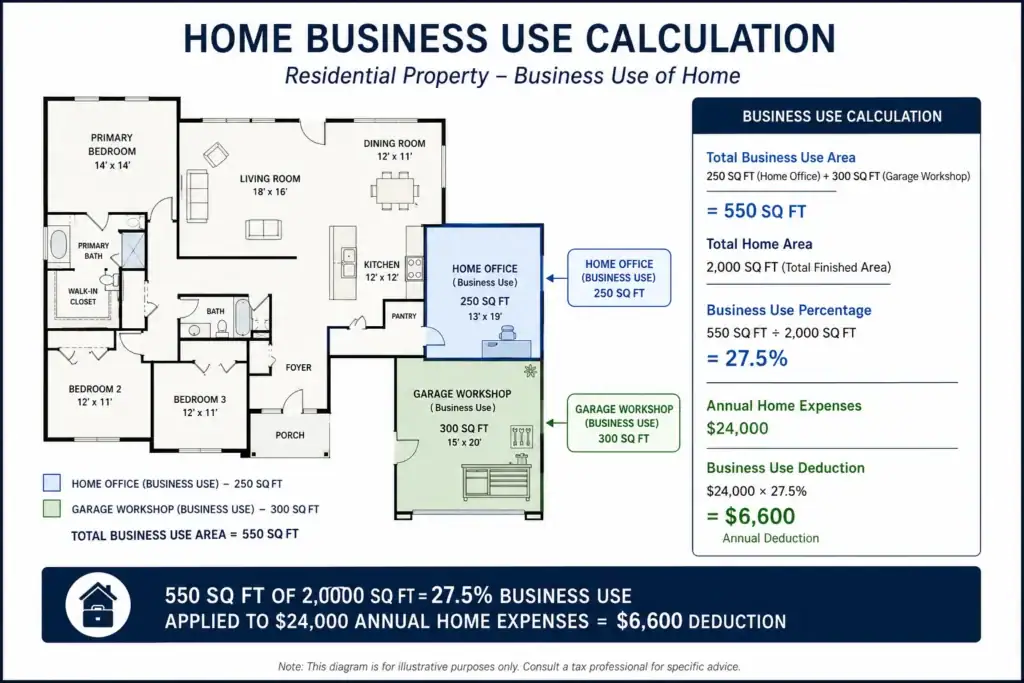
Calculating the Deduction
Step 1: Determine business-use percentage of home
Method 1: Square footage
- Total home: 2,000 sq ft
- Home office: 200 sq ft
- Business use: 10%
Method 2: Number of rooms
- Total rooms: 8
- Business rooms: 1
- Business use: 12.5%
Step 2: Calculate allowable home expenses
Deductible home expenses (business %):
- Mortgage interest or rent
- Property taxes
- Home insurance
- Utilities (heat, electricity, water)
- Maintenance and repairs (whole house)
- Cleaning
- Internet and phone (reasonable business portion)
NOT deductible:
- Mortgage principal payments
- Capital improvements (may qualify for separate CCA)
Step 3: Apply business-use percentage
Example:
- Total eligible home expenses: $28,000
- Business use: 10%
- Home office deduction: $2,800
Detailed vs. Simplified Method
Detailed method: Track all actual expenses, calculate business portion (shown above).
Simplified method: Flat rate of $2/square foot of office space, up to 300 sq ft maximum.
- Office: 200 sq ft × $2 = $400 deduction
Simplified is easier but usually results in lower deduction. Most contractors benefit from detailed method.
Special Rules and Limitations
Cannot create or increase a loss: Home office deduction cannot create a business loss. Can carry forward unused deduction to future profitable years.
Separate entrance: If home office has separate entrance customers use, may increase deduction eligibility.
Storage and workshop: Dedicated garage workshop or storage area for business equipment qualifies even if in residential space.
Documentation Requirements
Maintain:
- Floor plan showing business areas
- Records of home expenses (mortgage statements, property tax bills, utility bills)
- Business use percentage calculation
- Photos of home office/workshop/storage
At New Flow Bookkeeping, we help contractors calculate and document home office deductions correctly. We ensure you claim the maximum legitimate deduction while maintaining records that satisfy CRA requirements if ever reviewed.
Meals, Travel, and Entertainment
These deductions have special rules contractors must understand.
Business Meals – 50% Rule
When deductible: Meals consumed while traveling for business, meeting with clients, entertaining for business purposes.
Deduction limit: 50% of cost
Example:
- Lunch meeting with prospective client: $65
- Deductible amount: $32.50 (50%)
Not deductible: Personal meals even if you’re working
Exception: Long-haul truckers can claim higher percentage (80%) under specific rules.
Travel Expenses
Deductible travel costs:
- Accommodations
- Transportation (flight, train, bus, mileage)
- Taxi or rideshare
- Parking
- Meals (50% rule)
Key requirement: Travel must be for business purpose.
Example – Deductible:
- Travel to job site 3 hours away ✅
- Attend industry trade show ✅
- Meet supplier to view materials ✅
Example – Not deductible:
- Vacation with side meeting ❌
- Personal trip unrelated to business ❌
Entertainment Expenses – 50% Rule
When deductible: Entertaining clients, potential clients, or associates for business purposes.
Examples:
- Golf game with client: 50% deductible
- Hockey game tickets for customer: 50% deductible
- Holiday party for clients: 50% deductible
Keep records: Who attended, business purpose, cost.
Employee vs. Owner Meals
Employee meals (away from office): Generally 50% deductible
Your meals: More complicated. If you’re sole proprietor grabbing lunch while working, likely not deductible (personal expense). If meeting with client or traveling for business, 50% deductible.
What You CANNOT Deduct
Just as important as knowing what’s deductible is knowing what’s NOT.
Personal Expenses
Not deductible:
- Personal vehicle use
- Personal meals
- Personal phone/internet
- Clothing suitable for everyday wear (jeans, t-shirts, casual shoes)
- Personal life insurance
- Personal health insurance (may be deductible differently if incorporated)
Key principle: Must be incurred to earn business income. Personal benefit = not deductible.
Fines and Penalties
Not deductible:
- Parking tickets
- Speeding tickets
- Bylaw infractions
- CRA penalties and interest
Even if incurred during business activity, fines are specifically non-deductible.
Political Contributions
Political donations are not business expenses (though may generate personal tax credits).
Club Memberships
Generally not deductible:
- Golf club memberships
- Social club dues
- Fitness club memberships
Exception: Memberships in professional or trade associations ARE deductible (CHBA, ECA, etc.).
Commuting
Not deductible: Travel from home to your regular place of business.
Example:
- Home to office/shop every morning: Personal commuting ❌
- Shop to job sites during day: Business travel ✅
- Job site to job site: Business travel ✅
Exception: If you have home-based business and first trip of day is to job site, may be deductible.
Home as Principal Place of Business
If you claim home office deduction, be aware:
- May trigger capital gains issues when you sell home
- Consult accountant before claiming significant home office deduction
- Principal residence exemption may be partially limited
Usually the deduction is still worth it, but understand the implications.
Record Keeping Requirements
CRA allows deductions. CRA also audits. Without proper records, legitimate deductions get disallowed.
What Records to Keep
All receipts and invoices for:
- Materials and supplies
- Tools and equipment
- Vehicle expenses (fuel, maintenance, insurance)
- Subcontractor payments
- Professional fees
- Any other business expense
Supporting documentation:
- Mileage logs (vehicle expenses)
- Home office floor plan and expense records
- Equipment purchase agreements
- Lease agreements
- Bank statements and credit card statements
How Long to Keep Records
Minimum: 6 years from the end of the tax year they relate to.
Example: 2025 tax records must be kept until at least December 31, 2031.
Best practice: Keep longer if space allows, especially for capital assets.
Digital vs. Paper Records
CRA accepts digital records if:
- Legible and accurate
- Backed up securely
- Accessible if CRA requests
Digital tools:
- Scan receipts with phone apps (Dext, Receipt Bank, QuickBooks mobile)
- Cloud storage (Google Drive, Dropbox)
- Accounting software receipt attachment features
Advantages of digital:
- Won’t fade or get damaged
- Searchable
- Takes less space
- Easier to share with accountant
What If You Don’t Have Receipts?
Lost receipt for legitimate expense?
- Bank/credit card statement showing transaction
- Invoice copy from supplier
- Written explanation of expense
- Other supporting documentation
CRA may accept with sufficient evidence, but original receipts are always best.
No receipt and no other evidence?
- Cannot deduct
- This is why systems matter
Organizing for Tax Time
Monthly:
- Code all expenses to proper categories
- Reconcile credit cards and bank accounts
- File receipts (physical or digital)
- Update mileage log
Year-end:
- Summarize totals by category
- Calculate vehicle business-use percentage
- Complete home office calculation
- List capital asset purchases
Tax time:
- Provide organized summary to accountant
- Include notes on unusual items
- Review deductions before filing
Proper organization saves accountant time (lower fees) and maximizes legitimate deductions.
Conclusion
Tax deductions aren’t about pushing ethical boundaries or creative accounting. They’re about claiming what Canadian tax law allows you to deduct—reimbursing yourself for the real costs of running your contracting business.
The contractors who maximize legitimate deductions:
✅ Track expenses consistently throughout the year
✅ Maintain proper documentation (receipts, logs, records)
✅ Understand what’s deductible and what’s not
✅ Calculate complex deductions like vehicles and home office correctly
✅ Work with professional bookkeepers and accountants
✅ Plan proactively rather than scrambling at tax time
The difference between an organized contractor and a disorganized one isn’t how much tax they should pay—it’s how much they actually prove they’re entitled to deduct.
Start today:
- Set up a receipt tracking system (app or folder)
- Start a mileage log (app recommended)
- Measure your home office if applicable
- Keep a list of tool and equipment purchases
- Schedule monthly bookkeeping time (or hire a professional)
These simple habits save thousands in taxes year after year.
Ready to Stop Overpaying Taxes?
At New Flow Bookkeeping, we specialize in helping Canadian contractors maximize legitimate tax deductions through proper expense tracking and categorization.
We help you:
- Set up expense tracking systems that capture every deductible cost
- Calculate vehicle deductions with CRA-compliant mileage tracking
- Document home office deductions properly
- Track capital assets and CCA calculations
- Organize records for maximum deductions and audit protection
- Prepare year-end summaries your accountant will love
Whether you’re catching up on years of disorganized records or establishing systems for a new business, we provide contractor-specific bookkeeping expertise that pays for itself in tax savings.
Schedule your free consultation today and discover how much you’ve been leaving on the table. Most contractors are shocked by how much they can legitimately deduct with proper tracking.
Check out our other blogs:
- Bookkeeping for Consulting Firms: How to Track Project Profitability in QuickBooks Online
- What Is Bookkeeping? A Beginner’s Guide for Small Business Owners
